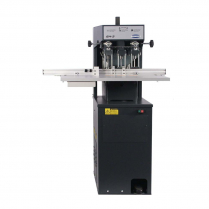
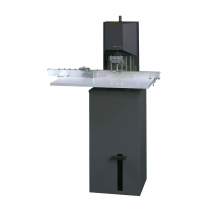
Hole punching and paper drilling at Print & Finishing Solutions (PFS) focus on high-volume efficiency and hole-positioning accuracy to eliminate the manual labor of hand-punching. We provide industrial-grade solutions from Challenge to handle everything from specialty digital finishing to heavy-duty bindery production.
Challenge Paper Drilling Technology
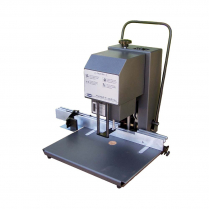
1. Challenge Single-Spindle Drills (Tabletop & Floor Models) The single-spindle series provides an entry-point for shops requiring professional hole drilling without the footprint of a multi-head machine.
- JF Model: A hand-lever operated drill that processes up to 2 inches of stock per stroke.
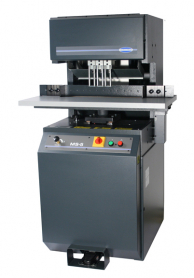
- MS-5 Model: A heavy-duty floor model utilizing a powerful motor to drill through 2.5 inches of paper, featuring a backgauge with adjustable stops for rapid multi-hole positioning.
- Ease of Maintenance: Features a standard automatic trip cycle and a simple sharpen-and-replace system for hollow drill bits to ensure clean edges on every lift.
2. Challenge Multi-Spindle Drills (High-Volume Production) Multi-spindle drills are engineered for high-repetition work, such as three-hole punching for binders, by drilling all holes simultaneously.
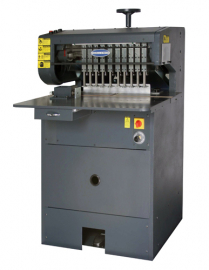
- MS-10 Series: Features up to 10 adjustable drilling heads, allowing a shop to go from a standard 3-hole punch to a complex custom pattern in minutes.
- Hydraulic Operation: Utilizes hydraulic power to drive the drill heads through 2.5-inch stacks, reducing operator fatigue and ensuring consistent speed regardless of paper density.
- Waste Management: Integrated large-capacity chip bins collect paper "slugs" during operation, keeping the work area clean and preventing mechanical jams.
Solving Drilling Failure Points
Q: Why are the edges of my holes scorched or brown? A: Scorching is caused by friction heat, usually from a dull drill bit or drilling at an incorrect speed for the substrate. We recommend using Teflon-coated drill bits for coated or glossy stocks and utilizing the Challenge MS-10’s adjustable stroke speed to reduce heat buildup.
Q: How do I prevent the bottom sheets from tearing or "slugging"? A: This occurs when the drill bit doesn't have a clean surface to cut against. Always use a fresh drill block (cutting stick) and ensure the drill depth is calibrated so the bit just barely touches the block. Challenge drills feature a micro-adjustable depth control to prevent premature bit wear while ensuring a clean cut through the final sheet.
Q: Can these drills handle synthetic materials like PVC or Teslin? A: Yes, but these materials generate significant heat that can melt the plastic to the bit. Utilizing the Challenge MS-Series with specialized hollow drill bits and periodic lubrication (wax sticks) allows for clean, burr-free holes in synthetic stocks that would destroy a standard office punch.
Technical Specification Matrix
|
Feature |
Challenge JF (Single) |
Challenge MS-5 (Single) |
Challenge MS-10 (Multi) |
|---|---|---|---|
|
Max Drill Depth |
2.0 Inches |
2.5 Inches |
2.5 Inches |
|
Number of Heads |
1 |
1 |
Up to 10 |
|
Operation |
Manual Lever |
Foot Pedal / Electric |
Hydraulic |
|
Backgauge |
Manual Stops |
Adjustable Auto-Stops |
Programmable / Manual |
|
Best For |
Short-run / Small Shop |
Mid-volume / Heavy Stock |
High-volume Bindery |
Critical Risk Assessment
The Challenge JF is a robust solution for occasional drilling, but the manual lever operation can lead to inconsistent hole quality if the operator does not maintain a steady stroke. For commercial environments, the MS-5 or MS-10 provides a significant safety and quality advantage through motorized and hydraulic cycles that eliminate human variability. While the MS-10 offers the highest throughput, shops must account for the additional setup time required to align multiple heads; for jobs requiring only one or two holes in various positions, the MS-5 often provides a faster "job-to-job" transition. Failing to regularly sharpen bits on any Challenge drill will lead to motor strain and jagged hole edges, regardless of the machine's power.