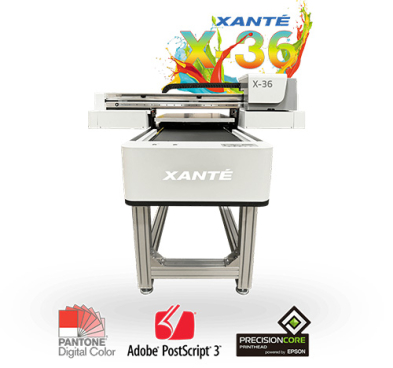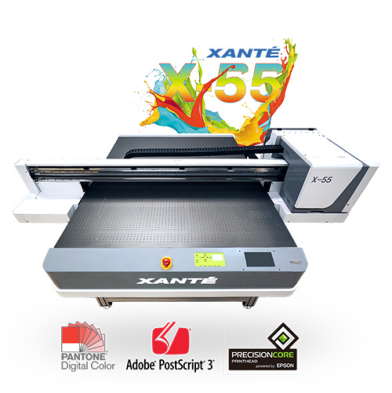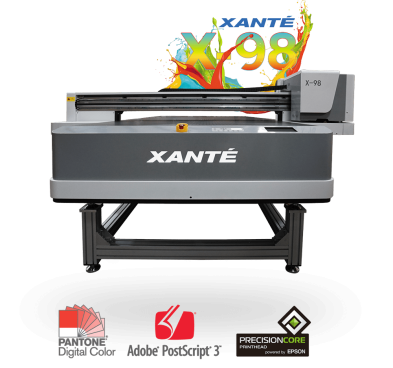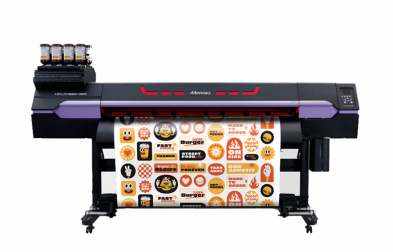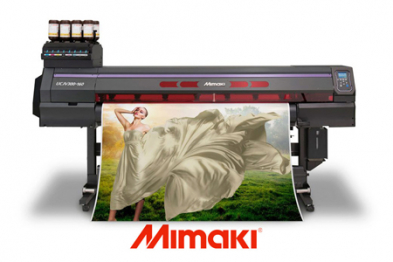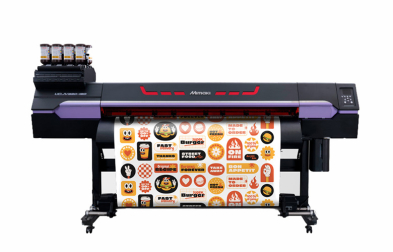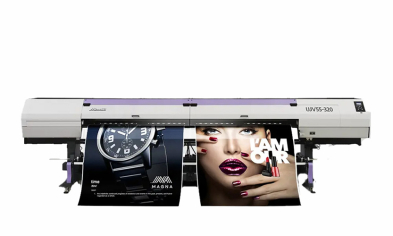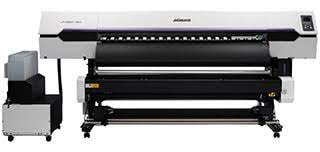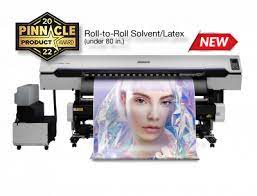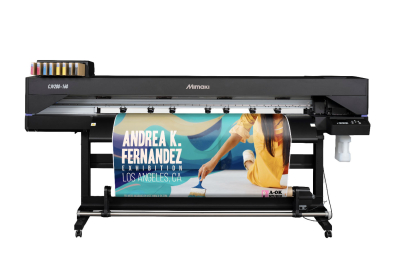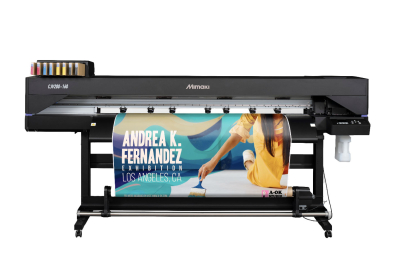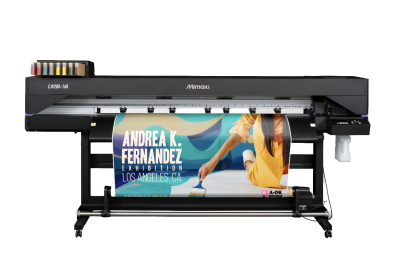
Wide-format selection at PFS centers on matching mechanical throughput to your specific substrate mix. We offer three distinct tiers: Mimaki for precision, Xanté for heavy rigid versatility, and CET Color for industrial-scale volume.
Wide-Format Tier Comparison: Mimaki, Xante, and CET Color
1. Mimaki: Specialized Detail and Integrated Finishing Mimaki is the industry standard for high-resolution graphics and innovative textile solutions.
- Integrated Workflow: The UCJV330-160 combines 1200 dpi printing with an onboard cutter for immediate decal and vinyl production.
- Specialized Output: The TxF 150/300 series provides dedicated Direct-to-Film (DTF) printing for apparel, featuring active white ink circulation to prevent nozzle failure.
- Surface Texture: The UJF Tabletop series utilizes 2.5D printing technology to create tactile textures and "spot varnish" effects with clear ink.
2. Xanté: Versatile Rigid Substrate Adhesion Xanté X-Series flatbeds (X-36, X-55, and X-98) are engineered for direct-to-object printing on heavy or unconventional materials.
- Extreme Media Clearance: Xanté systems support media up to 3 inches thick, allowing direct printing on wood, glass, stone, and pre-assembled industrial items.
- VHD UV Ink: High-density inks ensure superior adhesion to non-porous surfaces without requiring manual priming.
- Production Speed: The X-98 delivers high-quality signage at speeds exceeding 100 sq.ft./hr while maintaining up to 2880 dpi resolution.
3. CET Color: Industrial-Grade Throughput CET Color systems are designed for high-volume environments where square footage per hour is the primary KPI.
- Peak Capacity: The 1000H Linear Hybrid delivers industrial speeds up to 685 sq.ft./hr.
- Advanced Printheads: Utilizing Ricoh Gen 6 printheads in scalable configurations (up to 9 heads in 3 rows), these machines maximize pass efficiency.
- Large Format Capability: The 1000H supports a maximum print area of 126 inches for oversized industrial signage.
Solving Wide-Format Failure Points
Q: How do I eliminate "silvering" (tiny air bubbles) in my laminates? A: Use a heat-assisted laminator like the Mimaki LA-160W or the GFP 663TH. Applying 140°F heat softens the laminate adhesive, allowing it to flow into the UV ink's texture for a crystal-clear bond.
Q: What is the best way to cut rigid boards after printing? A: For standard foam and coroplast, the Safety Speed SSC Series handles heights up to 98 inches. For complex shapes and packaging, the Cutworx Eclipse 1007 flatbed die cutter provides automated universal cutting and creasing at 47.2"/sec.
Q: Can a single wide-format printer handle both rigid and flexible media without downtime? A: Hybrid systems like the CET Q6 Series utilize retractable registration pins and vacuum-zoned tables to switch between rigid boards and roll-based media. This eliminates the 30-minute setup time required by many legacy machines when changing media types.
Q: What is the ROI impact of UV-LED curing over traditional solvent printing? A: UV-LED technology, found in models like the Mimaki UJV100-160, enables instant curing. This allows for immediate post-print finishing—such as lamination on a GFP 663TH—eliminating the 24-hour outgassing period required for eco-solvent prints and increasing total shop throughput by 15-20%.
Technical Specification Matrix
|
Metric |
Mimaki UCJV330-160 |
Xanté X-98 |
CET 1000H Linear |
|---|---|---|---|
|
Max Speed |
301 sq.ft./hr |
>100 sq.ft./hr |
685 sq.ft./hr |
|
Max Resolution |
1800 dpi |
2880 dpi |
1200 x 1200 dpi |
|
Max Media Thickness |
0.04" (Roll) |
3.0 Inches |
2.0 Inches |
|
Primary Advantage |
Integrated Cut / DTF |
Rigid Object Adhesion |
Industrial Volume |
Critical Risk Assessment
Selecting a platform based solely on top-end speed often overlooks operational overhead. A CET hybrid offers massive throughput but requires more rigorous daily maintenance of its high-count printhead arrays. Xanté systems offer the best "thickness-to-footprint" ratio for specialty items but operate at slower speeds than industrial hybrids. Mimaki provides the most automated maintenance features (like NCU nozzle checking), making it the lowest-risk option for shops with limited dedicated maintenance staff.