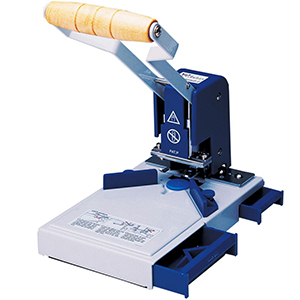
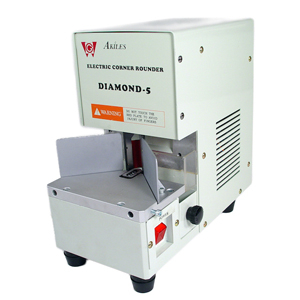
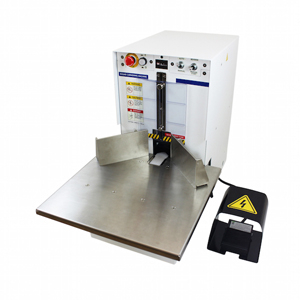
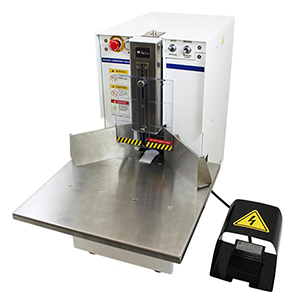
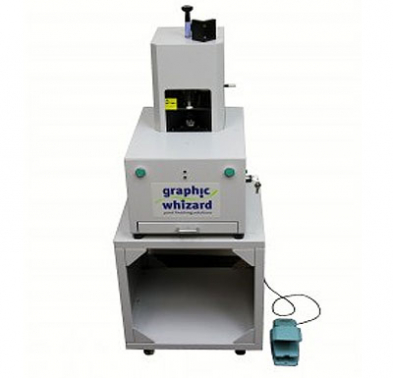
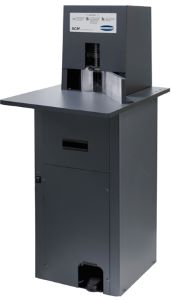
Professional corner rounding at PFS centers on providing a durable, ergonomic finish to business cards, menus, and marketing collateral. By eliminating sharp edges, these tools prevent substrate delamination and improve the longevity of high-use print products. We provide industrial-grade solutions from Challenge and Akiles to accommodate everything from tabletop short runs to high-volume hydraulic production.
Corner Rounding Technology Comparison
1. Akiles: High-Capacity Tabletop Versatility The Akiles series provides a versatile entry-point for shops requiring a variety of radii without a massive floor-space requirement.
- Diamond-7 Capacity: This heavy-duty manual rounder cuts through up to 2.75 inches (approximately 700 sheets of 20lb. paper) in a single stroke.
- Interchangeable Tooling: The system features 7 available die sizes (1/8", 1/4", 3/8", 1/2", 5/8", 3/4", and Straight) that can be swapped in seconds to match specific client needs.
- Operational Modes: Units are available in multiple configurations, including electric models to reduce operator fatigue during high-repetition sets.
2. Challenge: Industrial Hydraulic Durability Challenge corner rounders are engineered for heavy commercial use where mechanical longevity and consistent pressure are the primary KPIs.
- Titan Reliability: Built with the same heavy-duty steel philosophy as their world-renowned paper cutters, these units handle high-density stocks and plastics that often cause manual units to deflect.
- Hydraulic Precision: Utilizes hydraulic clamping and cutting to ensure that even the bottom sheet in a 4-inch stack maintains the exact same radius as the top sheet.
- Consistent Output: The automated hydraulic cycle eliminates the variability of manual pulling, providing a uniform finish across thousands of cycles.
Solving Corner Rounding Failure Points
Q: Why do the bottom sheets in my stack have a different radius than the top? A: This is known as "blade draw," typically caused by insufficient clamping pressure or a dull die. Challenge hydraulic units eliminate this by applying constant clamping force before the blade descends, ensuring the stack remains vertical and stationary throughout the cut.
Q: How do I prevent delamination when rounding heavy laminated cards? A: Delamination occurs when a dull blade "tears" the laminate film rather than shearing it. Using high-carbon steel dies found in the Akiles Diamond-7 ensures a clean shear through PET and OPP films up to 10mil thick, preserving the bond between the film and the substrate.
Q: Can I round corners on synthetic or plastic substrates? A: Yes. However, standard manual units may struggle with the density of PVC or Teslin. We recommend the Challenge or Akiles electric models which provide the consistent mechanical torque required to penetrate non-paper synthetics without melting or shattering the edges.
Technical Specification Matrix
|
Feature |
Akiles Diamond-7 |
Challenge Series |
|---|---|---|
|
Max Stack Height |
2.75 Inches |
Up to 4.0 Inches |
|
Die Sizes |
7 Options (1/8" - 3/4") |
Standard Industrial |
|
Drive Type |
Manual or Electric |
Hydraulic |
|
Footprint |
Tabletop |
Floor Standing |
|
Best For |
High-mix / Small-to-Mid volume |
High-volume / Heavy industrial |
Critical Risk Assessment
Selecting a manual corner rounder for jobs exceeding 5,000 units per month will lead to repetitive strain injuries and inconsistent quality as the operator tires. Conversely, investing in a hydraulic Challenge unit for a shop that only rounds 100 business cards a week will yield a negative ROI due to the higher initial capital expenditure. For shops currently running the IntoPrint SP1360W for heavy-stock invitations, the Akiles Diamond-7 electric model is the most balanced choice, providing the necessary power to cut through thick toner-fused stocks without the footprint of an industrial hydraulic machine.