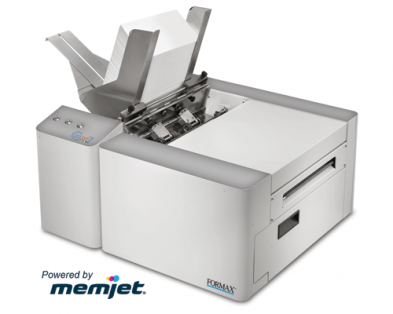
Mailing and document processing at Print & Finishing Solutions (PFS) focus on automating the transition from printed sheet to ready-to-mail piece. We provide two strategic paths: Formax for industry-standard folding, inserting, and pressure sealing, and Elan for high-speed industrial print-and-mail integration.
Mailing Technology Comparison
1. Formax (Automated Folding, Inserting, and Sealing) Formax is the benchmark for mid-to-high volume mailrooms requiring reliable automation of invoices, statements, and direct mail.
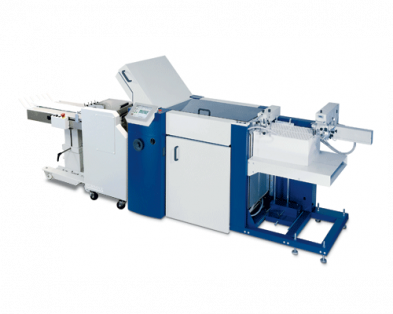
- Pressure Sealers: The AutoSeal series utilizes high-pressure rollers to activate a cohesive glue pattern on one-piece mailers, eliminating the need for envelopes and reducing total postage weight.
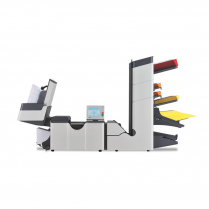
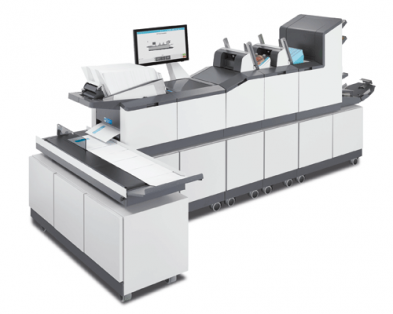
- Inserter Systems: The 6000 Series handles high-speed inserting of varied document types, featuring high-capacity feeders and intuitive "load-and-go" operation to minimize manual handling.
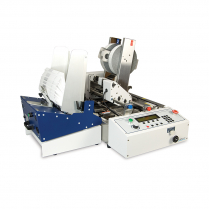
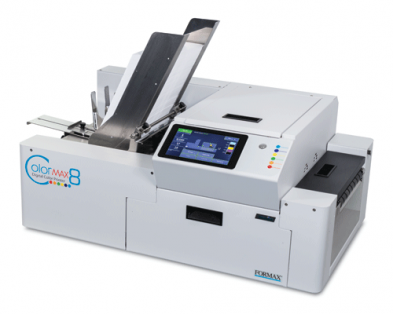
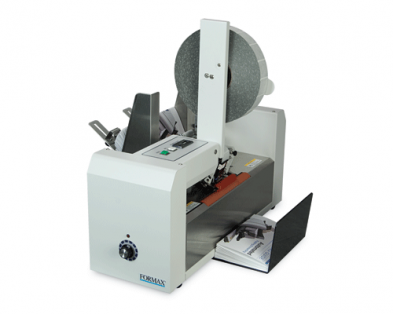
- Digital Address Printers: These systems utilize inkjet technology to print USPS-compliant barcodes and addresses directly onto envelopes or mailers at production speeds.
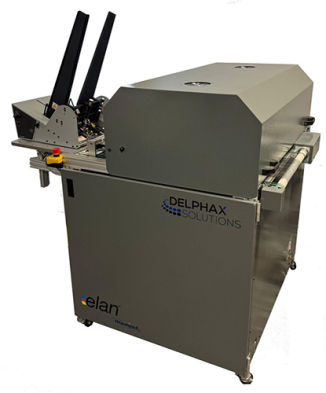
2. Elan 170 Series (Industrial Inkjet Mailing) The Elan 170 is a high-performance inkjet system designed for the most demanding high-speed print-and-mail environments.
- Direct-to-Mailer Production: Specifically engineered to integrate inline or near-line with finishing equipment, the Elan 170 prints variable data at industrial velocities.
- Print Engine Precision: Utilizes advanced printhead technology to deliver sharp, high-contrast text and barcodes, ensuring 100% USPS readability and tracking accuracy.
- Substrate Versatility: Designed to handle the high-static and textured environments common in high-volume mailing facilities, ensuring consistent ink adhesion across varied stocks.
Solving Mailing Production Failure Points
Q: How do I reduce the cost of envelopes for high-volume billing? A: Switch to a "One-Piece Mailer" using a Formax AutoSeal system. By using pressure-seal forms, the document itself becomes the envelope. This eliminates the cost of a separate outer envelope and reduces the labor associated with traditional stuffing and sealing.
Q: Why do my inkjet addresses smear during USPS sorting? A: Smearing is usually caused by using dye-based inks on glossy or coated stocks without sufficient drying time. Systems like the Elan 170 and Formax address printersutilize specialized ink formulations that bond quickly to the substrate, ensuring that barcodes remain scannable through the entire postal sorting process.
Q: Can I automate the mailing of multi-page statements with varying inserts? A: Yes. Formax Inserter systems utilize OMR (Optical Mark Recognition) or BCR (Barcode Recognition) to "read" each sheet. The system automatically pulls the correct number of pages and specific inserts for each recipient, ensuring high-integrity mailing for sensitive financial or medical documents.
Technical Specification Matrix
|
Feature |
Formax AutoSeal (Sealer) |
Formax 6000 Series (Inserter) |
Elan 170 Series (Print) |
|---|---|---|---|
|
Primary Function |
Envelope-Free Sealing |
Envelope Stuffing |
High-Speed Addressing |
|
Max Speed |
Up to 40,000/hr |
High-Volume Industrial |
Industrial Inkjet Speed |
|
Media Type |
Pressure Seal Forms |
Sheets & Envelopes |
Direct-to-Substrate |
|
Variable Data |
No |
Yes (via Barcode) |
Yes (Full Variable) |
|
Best For |
Invoices / Payroll |
Multi-Page Statements |
High-Volume Personalization |
Critical Risk Assessment
While Formax AutoSeal systems offer the lowest cost per piece for single-sheet mailers, they limit your ability to include external marketing inserts. For shops requiring complex, personalized communication, a Formax Inserter provides the necessary flexibility, though at a higher mechanical complexity. The Elan 170 is an industrial-scale powerhouse for addressing, but it requires a consistent volume of thousands of pieces per hour to justify its high-speed printheads. Failing to properly match your ink type to the substrate in an Elan or Formax printer will lead to significant USPS rejection rates due to unreadable barcodes.